
On this page you will find some key resources setting out the principles of good design for cycling infrastructure, and other resources to help you campaign, and to keep you informed about cycling-related issues. The material is divided into the following sections:
Infrastructure Design
This section contains key design documents, setting out the principles of good infrastructure design. LTN 1/20, Gear Change and Segregated Cycling Infrastructure are dedicated to bikes. Streetscape Guidance has wider brief, but contains sections related to cycling.
Cycle Infrastructure design: LTN 1/20
LTN 1/20 is the Department for Transport’s (DfT’s) flagship guidance for local authorities, published in 2020. Local authorities are expected to take note of this guidance when designing cycling infrastructure.
The guidance sets out 5 core principles, based on best practice internationally and in the UK. Networks and routes should be Coherent; Direct; Safe; Comfortable and Attractive. LTN 1/20 sets out the practical steps to achieve the 5 core principles.
Report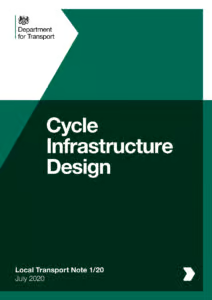
Gear Change
Gear Change is the Department for Transport’s clarion call for active travel. Published in 2020, alongside LTN 1/20, the document sets out the benefits of active travel, and sets the agenda for making it happen. It is clear that cyclists should be treated as vehicles, rather than pedestrians, and gives key design principles for cycling infrastructure. It calls for cycle provision segregated from pedestrians and motor vehicles, low-traffic neighbourhoods, school streets and much more.
Report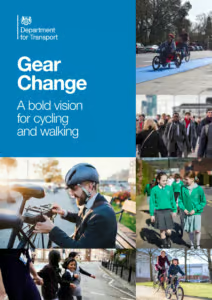
Guide to Inclusive Cycling
Wheels for Wellbeing has created a guide to demonstrate how to make cycling infrastructure accessible to all. It covers the legal context as well as good design principles.
Report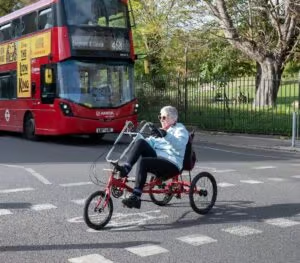
Guide to Low Traffic Neighbourhoods
The Walk Wheel Cycle Trust (formerly Sustrans) has created an introductory guide to Low Traffic Neighbourhoods (LTNs). It covers everything from advocacy and design considerations, to the evidence in favour of LTNs.
Report
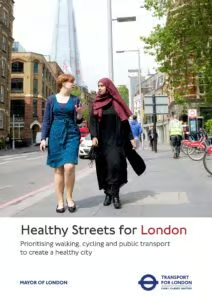
Healthy Streets for London
Although focused on London, this report has some powerful statistics showing why Active Travel is so important. As it says:
“We urgently need to design physical
activity back into our everyday lives.
Active travel – walking more, cycling more, using public transport more – provides the easiest and most affordable way for us all to get more active and live healthier lives.
“In addition to these health benefits, all the evidence shows that more active travel will reduce air and noise pollution, help combat social isolation, ease congestion, make us safer and bring economic benefits to businesses…”
Streetscape Guidance
This weighty, and at times technical, document from Transport for London, published in 2017, covers a wide range of streetscapes. It sets out best practice design principles for London streets and places, but the principles could be applied more widely.
There are a number of sections of particular relevance to cyclists:
- 8.4 Cycle Infrastructure
- 9.8 Pedestrian and cycle bridges
- 11.5 Cycle parking
- 11.6 Cycle hire docking stations
- 14.9 Cycle parking hubs
There are case studies (see for example Royal College Road on p.36), and an underlying ambition to make walking and cycling the most competitive transport modes for short and medium length journeys.
The usual good design principles are applied to cycle routes – make them safe, continuous, clear, coherent, and attractive. Reducing vehicle speeds is recognised as essential to increasing pedestrian and cyclist safety.
Report
Segregated Cycling Infrastructure
This weighty, and at times technical, document from Transport for London, published in 2017, covers a wide range of streetscapes. It sets out best practice design principles for London streets and places, but the principles could be applied morThis Transport for London document sets out the benefits of segregated cycling facilities. Segregated facilities are seen as essential to make the transition to active forms of travel. The Mayor of London set a target date of 2041 to reduce car journeys by 3m a day, and to increase journeys by public transport, cycling and walking from 64% of all journeys in 2016 to 80%.
The report is full of interesting statistics. 79% of trips in London are by motor vehicle, but would take most people less than 20 minutes by bike. In Copenhagen, the risk of serious collisions was reduced by 72% per kilometer cycled, by introducing segregated cycle routes. Crucially, segregated cycling facilities reduce the perceived risks of cycling, and are instrumental in getting people on their bikes.
Report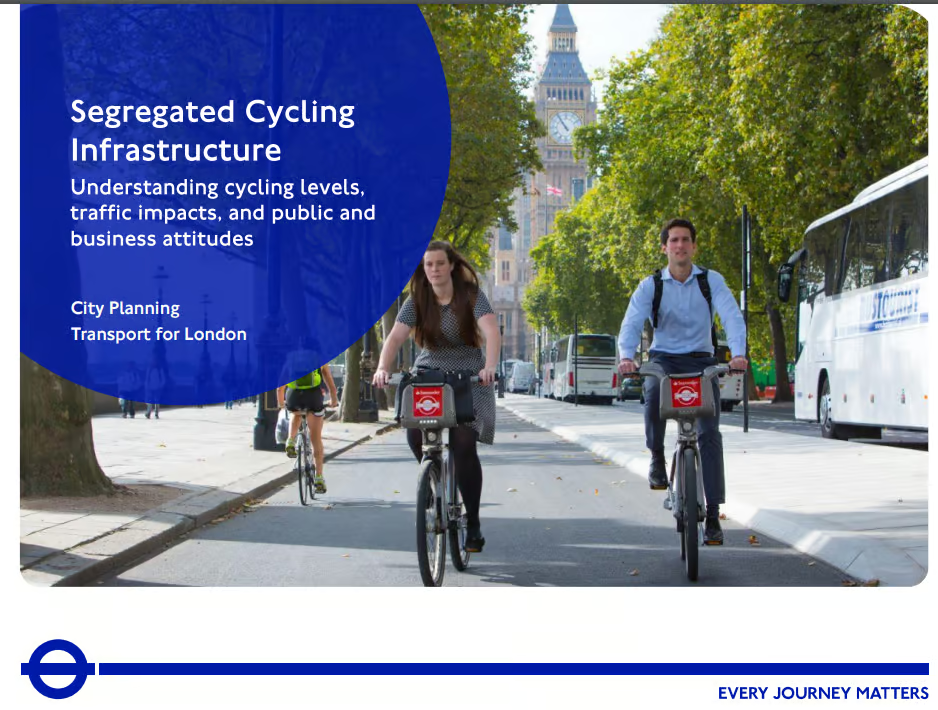
Campaigning Tips
Infrastructure Design WCC Policies Webinars/blogs
The documents in this section help to develop arguments in favour of cycling. How does it help businesses and economic development? What contribution does it make to health and wellbeing? What is the return on investment, in comparison with other transport investments.
Cycling UK’s Campaigning Handbook
Cycling UK is the UK’s leading cycling charity. It has a wealth of experience in cycle advocacy and campaigning. The Campaigning Handbook is their easily digestible introduction to effective local campaigning.
Report
Cycling UK’s Election Toolkit
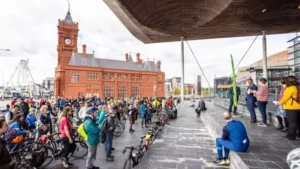
Cycling UK has some great campaigning resources to use around election times. They cover creating an advocacy plan, arranging a hustings, orgainising campaign stunts, using social and traditional media, and much more.
Report
Healthy Streets: a business view
Commissioned by Transport for London in 2017, with research carried out by the University of Westminster, this report sought the views of London’s Business Improvement Districts (BIDS) on the benefits for Healthy Streets. 76% of BIDS responded, and 85% of those BIDS said a good environment for walking and cycling was good for business. Reducing motor traffic was seen as positive for an area’s vitality, increasing footfall and even helping to recruit and retain staff. The report defines the 10 indicators of Healthy Streets.
Report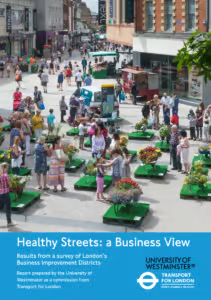
Stride and Ride
Published in 2024 by the Institute of Public Policy Research (IPPR), Stride and Ride makes the case for more investment in Active Travel. We’re starting from a low base. Between 2016 and 2021, London invested £24 per person per year on Active Travel, but the rest of the country invested only £10 per person per year. This was a mere 2% of the total transport spend. £148 per person per year was spent on road development over the same period.
The IPPR argues that we need to be spending £35 per person per year on Active Travel by 2028 to help deliver a world class Active Travel Network. They justify this by making the case in terms of: Cost of Living; Economics; Health; Environment; and Safety.
Every £1 spent on Active Travel returns £5.62 in benefits. Contrast this with only £2.50 in benefits for every £1 spent on road building (and that is a best-case figure!).
Report
WCC Policies
Infrastructure Design Campaiging Tips Webinars/blogs
WCC has some excellent policies that reflect national infrastructure design standards. However, their delivery does not live up to the promise of their strategies and plans. They need to develop ambitious, measurable delivery targets against which they can be judged.
Warwickshire’s Local Cycling and Walking Infrastructure Plan (LCWIP)
The Warwickshire Local Cycling and Walking Infrastructure Plan (LCWIP) is a long-term, county-wide plan for investment in walking, wheeling and cycling routes and Active Travel Zones. It was approved by Warwickshire County Council in February 2024.
The key aim of the Warwickshire LCWIP is, “To create a safe and attractive environment for walking, wheeling and cycling, so that they become the natural choices for shorter journeys and outdoor recreation in Warwickshire”.
Report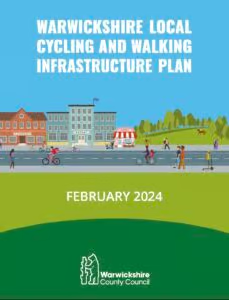
WCC Active Travel Policy
Warwickshire County Council (WCC) has a good Active Travel Policy document. It recognises that walking and cycling are the most efficient modes of transport for local journeys. Walking and cycling is good for physical and mental wellbeing. This helps to reduce the wider health costs associated with inactivity and contributes to community wellbeing.
The policy recognises strong public support for improving walking and cycling facilities.
WCC undertakes to design to the latest standards, and to create local walking and cycling routes which offer coherent, safe,
comfortable, attractive, direct connections that are accessible to all.
Fine words but, unfortunately, delivery in Warwickshire has not lived up to them. We need ambitious, measurable targets against which to hold WCC to account.
Report
Warwickshire Local Transport Plan 4 (LTP4)
Warwickshire County Council’s (WCC’s) Local Transport Plan 4 (LTP4) covers 6 themes.
- The Active Travel Strategy
- The Public Transport Strategy
- The Motor Vehicle Strategy
- The Managing Space Strategy
- The Safer Travel Strategy
- The Freight Strategy.
The plan was adopted in July 2023, and supports Warwickshire County Council’s response to the climate emergency and the county’s moves towards Net Zero carbon.
LTP4 contains a Travel Hierarchy. It states: “Improvements around our key themes will be achieved through a shift in travel behaviours to use forms of transport that promote wellbeing and are environmentally sustainable.”
In line with this aim, Walking, Cycling and Wheeling are at the top of the hierarchy, followed by public transport, with private vehicles at the bottom of the priority list. Once again, fine words that are yet to be matched by action.
Report
Webinars/blogs
Adam Tranter’s #BikeIsBest blog. Adam was formerly the West Midlands Cycling & Walking Commissioner, and his blog is a great source of cycling-related information.
Active Travel Café. This is a weekly webinar dedicated to all things active travel, with a wide range of speakers from Xavier Brice (the outgoing CEO of Walk Wheel Cycle Trust – formerly sustrans) to Engineers working on cycle infrastructure ,and everything in between. It’s been going for many years so there are dozens of highly informative videos, one of which includes our very own Bicycle Mayor, Simon Storey. They also have a YouTube Channel.